6. Blockchain Networks
Cities have the capability of providing something for everybody, only because, and only when, they are created by everybody.1
What makes a great city?
The world’s best metropolises are a mix of public and private spaces. Parks, sidewalks, and other shared spaces attract visitors and improve daily life. Private spaces create incentives for people to build businesses, adding variety and essential services. A city with only public spaces would lack the creative vitality that entrepreneurs bring. A city owned by a private company would, in contrast, be a soulless simulacrum.
Great cities are built from the ground up by many different people with varying skills and interests. The public and private depend on each other. A pizza shop attracts pedestrians off the sidewalk, converting them into customers. But it also brings more people to the sidewalk and helps pay for its maintenance with its contribution to city revenues through taxes. The relationship is symbiotic.
Urban planning provides a helpful analogy for the design of networks. Of the existing large networks, the web and email are the closest to great cities. As we’ve said, the communities that build on these networks govern them and receive their economic benefits. Communities, not companies, control the network effects. Entrepreneurs have a strong incentive to build on top of these networks because of predictable rules that guarantee they own what they build.
The internet should feature the same balance between public and private spaces as seen in healthy cities. Corporate networks are like private real estate that entrepreneurs can develop. They are nimble and resourceful. But their success can subsume the commons, crowd out alternatives, and reduce opportunities for users, creators, and entrepreneurs.
An alternative to protocol and corporate networks is needed to restore the internet’s balance. I call these new networks blockchain networks because they have blockchains at their core. Bitcoin was the first blockchain network. Satoshi Nakamoto and the project’s other contributors built it for a specific purpose: cryptocurrency. But more generalized constructions are possible. Technologists have since extended the underlying design of blockchain networks—and the closely related concept of tokens, which enable distributed ownership—to many more kinds of digital services. They’ve extended it not just to financial networks, but also to social networks, game worlds, marketplaces, and more.
Before blockchains, network architectures were more limited. With traditional computers, the people who own the computer hardware are in charge. They can change the software however and whenever they like. Therefore, when designing networks for traditional computers, one must assume that any software acting as a network node can potentially “turn evil”—changing behavior to serve the interests of the owner over the interests of the network’s users. This assumption restricts the range of feasible network designs. Historically, only two have worked: (1) protocol networks, where a long tail of weak network nodes limits power to the point that it doesn’t matter if some nodes turn evil; and (2) corporate networks, which invest all power with the corporate owners in the hope that they don’t act badly.
Blockchain networks take a different approach. Recall that blockchains put software in charge, inverting the traditional relationship between hardware and software. This allows network designers to take full advantage of the expressivity of software. They can engineer blockchain networks to have persistent rules encoded in software that are resilient to changes in the underlying hardware. The rules can cover every aspect of the network, including who gets access, who pays fees, how much gets charged, how economic incentives are allocated, and who can modify the network under what circumstances. Blockchain network designers write the core network software but don’t need to worry about nodes in the network turning evil and undermining the system. They can instead rely on built-in consensus mechanisms to keep nodes in check.
Blockchains make network design as rich and expressive as software, and they do so on top of solid, persistent foundations. The designs I describe ahead represent what I believe to be the emerging best practices for blockchain networks, but the breadth of opportunity afforded by software’s design space could have broader implications than what I discuss. It is possible that there will be other network designs—ones not yet even considered—that will improve upon the ideas presented here. In fact, I expect that to be the case, since almost any network design one can imagine can be encoded in software.
I should note that I use “blockchain networks” as an umbrella term to describe both infrastructure and application layers of the tech stack. If you recall, the internet is like a layer cake. Networking across devices comes at the bottom of the stack. Infrastructure blockchain networks build on top of this. Some of the most popular general-purpose infrastructure networks include Ethereum, Solana, Optimism, and Polygon. Above this layer are application blockchain networks, including DeFi networks like Aave, Compound, and Uniswap, and newer networks that power things like social networks, games, and marketplaces.
(A quick note about terminology. Many industry practitioners refer to application blockchain networks as “protocols.” As I’ve said before, I avoid this naming convention to prevent confusion with protocol networks, like email and the web, which are, in my framework, a separate category. It doesn’t help that some blockchain-related companies take their names from the underlying application networks that they’re built on. Compound Labs, a company that makes client software, is distinct from Compound, the underlying application network, for example. Compound Labs develops websites and apps that provide access to Compound, the underlying network, similar to the way Google develops Gmail to access email.)
Although blockchains have been around for more than a decade, they have started operating at internet scale only in the past few years. This is due to improvements in blockchain scaling technology, which lowers the usage fees blockchains charge and increases the throughput and speed of transactions. In the past, blockchain transaction fees were too unpredictable and steep for high-frequency activities like social networking. Imagine paying a few dollars every time you want to upload a post or click “like”—it would be impractical. In contrast, DeFi networks succeeded despite scaling limits because they generally perform low-frequency, high-volume transactions. If you’re dealing with tokens valued at tens, hundreds, or thousands of dollars, paying a few dollars in fees is less of an imposition.
Blockchain performance is steadily improving, following the same platform-app feedback loop that has propelled past computing waves. New infrastructure enables new applications, which in turn drives investment back into infrastructure. Early blockchains like Bitcoin and Ethereum currently process 7 to 15 transactions per second (TPS) on average. Higher-performance blockchains have increased performance by multiple orders of magnitude, including Solana (65,000 TPS), Aptos (160,000 TPS), and Sui (11,000–297,000 TPS). In addition, Ethereum has continued to deliver on its road map of technology updates, which has the potential to scale throughput by more than a thousand times. Evaluating blockchain performance fairly and accurately can be a challenge due to the particularities of each network and the nuances involved in benchmarking; nevertheless, the progress here has been promising.
A variety of technologies have contributed to these performance improvements. One example, in Ethereum’s case, is “rollups”: second-layer blockchain networks that shift heavier computations “off chain” to traditional computers and then send the results back to the blockchain so that it can verify their correctness. These “layer two” systems build on developments in theoretical computer science that make it so computers can verify computations more efficiently than they can perform those same computations. They depend on advanced cryptographic and game-theoretic methods that have taken technologists years to perfect. Rollups increase the processing power of blockchains while maintaining the strong commitment guarantees that make them useful in the first place.
Today, many applications that can be built using corporate network architectures can also be built using blockchain architectures. But elaborate infrastructure optimizations are often required, meaning that development teams need to have both application and infrastructure expertise, which makes development more difficult and expensive.
As we’ve seen in past computing cycles, a key moment will be when the infrastructure becomes good enough that application developers no longer need to think about infrastructure. If a team is building a blockchain-based video game, it shouldn’t have to worry about esoteric infrastructure scaling issues. Its exclusive focus should be on making the game fun. Similarly, before the iPhone, developers had to be experts in both application design and GPS technology to build location-based applications. The iPhone abstracted away the infrastructure complexity and let developers do what they do best: build great user experiences. Based on current trends, blockchains should reach a point where division of labor acts as a force multiplier in the next few years.
The benefit of building on blockchain networks is that they combine—and improve on—the most desirable properties of earlier network designs. Like corporate networks, blockchain networks can run core services that enable advanced functionality, but they do so on decentralized blockchains rather than on private company servers. Like protocol networks, blockchain networks are governed by communities. And both protocol and blockchain networks have predictability—as well as low or no take rates—which encourages innovation at the network edges.
Yet the built-in economics of blockchain networks make them more powerful than protocol networks could ever hope to be, and I say that as a longtime believer in and supporter of protocol networks. The revenue-generating take rates of corporate and blockchain networks can fund core services and allow these networks to attract capital and make investments to accelerate growth. Unlike corporate networks, though, blockchain networks have weak pricing power, meaning they cannot easily raise take rates (for reasons we’ll discuss in depth in “Take Rates”). This constraint—hard-capped pricing power—benefits the community and further encourages people to build on, create for, and participate in the network.
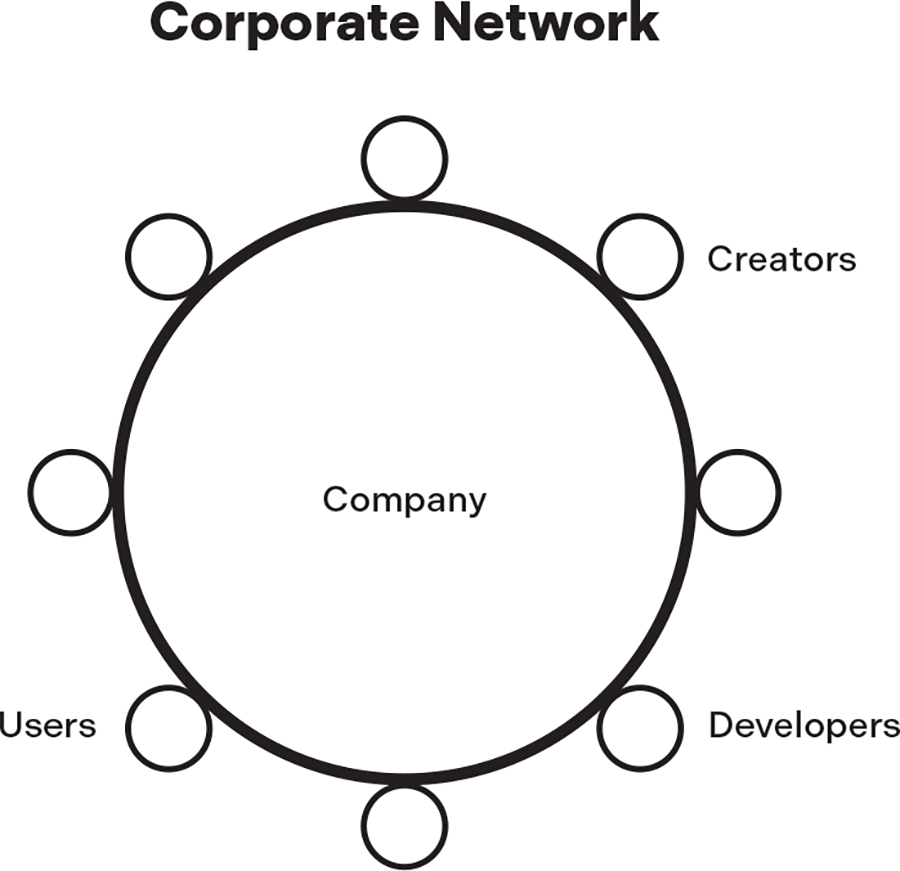
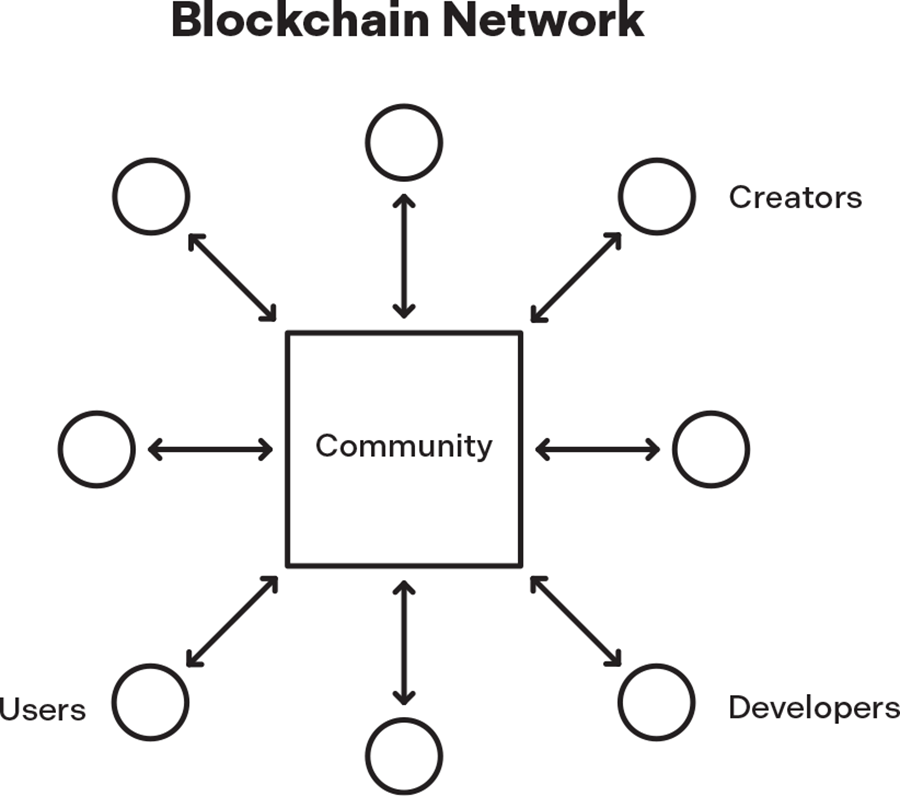
Each network type has a distinct shape and structure based on its unique qualities. We’ve already seen how protocol networks distribute power broadly among participants and how corporate networks are lorded over by, well, corporate overlords. The architecture of blockchain networks is different from both. Blockchain networks inhabit the “Goldilocks zone.” They consist of small core systems surrounded by rich ecosystems of creators, software developers, users, and other participants. Whereas corporate networks centralize most activities in a bloated core and protocol networks have no core, in blockchain networks the core is just right—big enough to support basic services, but not so big as to monopolize the network.
Blockchain networks are logically centralized but organizationally decentralized. Logical centralization means that centralized code maintains the canonical state of the network. Blockchains allow rules to be encoded in software that can be overridden by neither the hardware nor the people who own the hardware. The core software runs on a blockchain (or “on chain”) and contains basic system services that allow network participants to agree on the state of the virtual computer. Depending on the type of network, the core state can represent things like financial balances, social media posts, game actions, or marketplace transactions. Having a core makes it easy for developers to build around the network while also providing a mechanism—such as the ability to take a small cut of transactions—to accrue capital that can be reinvested in growth.
| Network Architecture | Strengths | Weaknesses |
|---|---|---|
Corporate Network (e.g., Facebook, Twitter, PayPal) |
Can raise, hold, and deploy capital. Centralized services: easy to upgrade, advanced functionality. |
Corporate-controlled network effect; high take rate, unpredictable rules. Once at scale (extract phase), weak incentives for users to participate and creators and developers to build on top. |
Protocol Network (e.g., web, email) |
Community governance and community-controlled network effect. Strong incentive for users to participate and creators and developers to build on top. Zero take rate. |
Can’t raise or hold capital. Hard to fund core development. Can’t provide network funding and incentives. Having no center of network where code and data can reside limits functionality. |
Blockchain Network |
Software core can raise, hold, and deploy capital. Maintains core services, upgradable, advanced functionality. Community governance and community-controlled network effect. Strong incentive for users to participate and creators and developers to build on top. Low take rate. |
New and relatively early adoption, limited user interfaces and tooling. Performance limits sophistication of on-chain code. |
Corporate networks are logically centralized too. They run core code in privately owned data centers, rather than on distributed virtual computers. But corporate networks are also organizationally centralized. The design has advantages, but it comes at a price: company management controls the hardware and can change the rules of the network at any time, for any reason. This leads to the inevitable “attract-extract” pattern, which feels to network participants like a bait and switch, as discussed in “Corporate Networks.”
Blockchain networks avoid this fate by placing control of the network in community members’ hands. The communities can consist of a variety of stakeholders, including token holders, users, creators, and developers. In most modern systems, changes to a blockchain network can occur only by a vote, usually by users who hold tokens that represent governance rights. This provides assurances to those who depend on the network that the rules will change only when it’s in the community’s interest. (I cover blockchain governance, including its challenges and opportunities, in “Network Governance.”)
Blockchain networks usually don’t start out organizationally decentralized, though. In their embryonic stage, they almost always have a small founding team that is managed from the top down. Afterward, a larger, bottom-up community of builders, creators, users, and others takes on maintenance and development duties. There’s no limit to how large these communities can get; many blockchain communities today number in the hundreds, thousands, or more. The job of the founding team is to design the core software for the network and an incentive system that encourages growth. After that, they hand control over to the community through a process of progressive decentralization.
An important consideration is deciding what should be centralized and what should be left to community development. The goal shouldn’t be to pack everything into the core and mimic corporate networks. Too much centralization will re-create the same problems that corporate networks produce. There should be some central planning, but entrepreneurs should do the bulk of the development. As a rule, if a component of the system can be shifted to the community, it should be. The core should perform only basic services on chain, such as managing governance and community incentives.
One common aspect the community might control is the treasury, a blockchain network’s financial core. The communities that control these treasuries are, as we’ve covered, sometimes called DAOs, or decentralized autonomous organizations. DAOs are somewhat misnamed. They’re not autonomous like self-driving cars are autonomous. Rather, they’re autonomous in the sense that they are blockchain based; the code that governs them runs on chain and can self-execute when certain conditions are met, such as when participants reach a consensus, usually through token voting. On-chain code can run in perpetuity, execute programmatically, and hold money without depending on outside institutions. DAOs are like the network equivalent of homeowners’ associations, making and enforcing rules for communities, but with more automation.
Consider the city analogy again. In a well-designed city, you would expect to have a town hall, a police department, a post office, schools, sanitation crews, and other essentials. Residents and businesses depend on these services, which offer a foundation upon which to develop the rest of the city. Municipal services are centralized for efficiency, but they are still beholden to the populace. The community controls the services through elections.

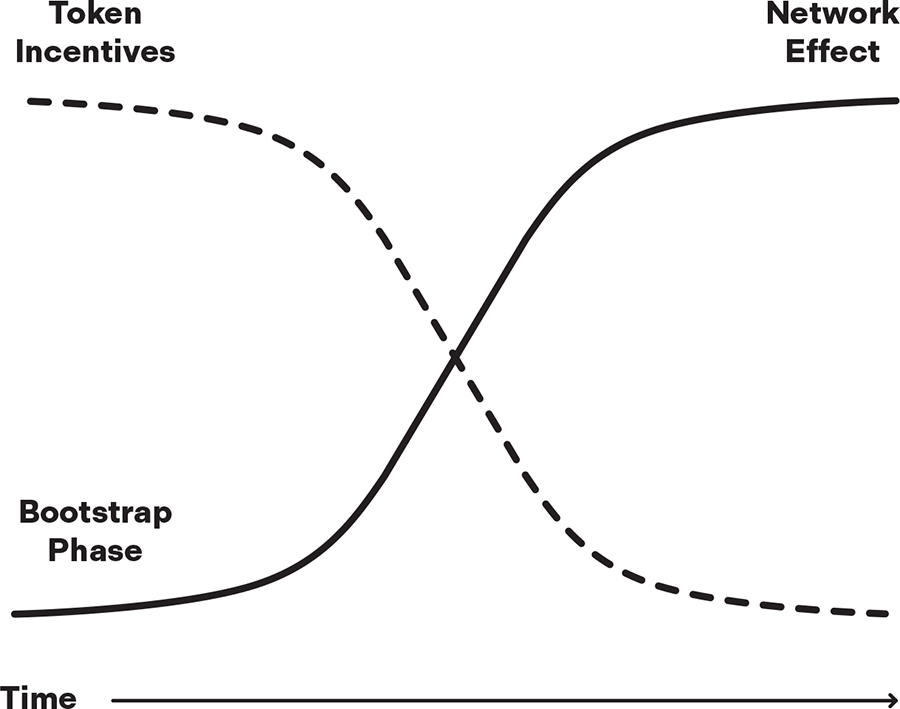
Blockchain functions have neat analogues in urban planning. Starting a blockchain network is like building a new city on undeveloped land. The city designer constructs some initial buildings and then designs a system of land grants and tax incentives for residents and developers. Property rights—ownership—play a key role, providing strong commitments that property owners will get to keep what they own and can feel comfortable investing in it. As the city grows, so does the tax base. Taxes are reinvested into public projects like streets and parks, more land is given away, and the city grows.
In the case of blockchain networks, token rewards are like land grants, incentives given to contributors for various activities. Tokens confer ownership, enshrining property rights. Take rates are like city taxes, fees the network charges for access and transactions. DAOs are like city governments, responsible for overseeing the development of infrastructure, resolving disputes, and allocating resources to maximize the network’s value. Through this combination of features, successful blockchain networks encourage bottom-up, emergent economies.
Imagine you are an entrepreneur looking to start a local business. The first thing you will want to know is the rules of the city you’re in. Are they predictable? Will any rule change follow a fair process? Are the taxes reasonable? If your business succeeds, will you receive the financial upside? Fairness and predictability encourage you to invest your time and money. Your success and the city’s success are mutually dependent. You have an incentive to help the city grow and prosper, and the city has an incentive for you to grow and prosper as well. The considerations are the same in a blockchain network.
The bottom-up, collaborative software development model of blockchain networks might seem strange to those more familiar with the top-down, corporate software development model. But bottom-up development is what built protocol networks and continues to build open-source software. It is also the same spirit of crowdsourced collaboration that powers websites like Wikipedia. Blockchain networks take this long-standing model and apply it to the killer app of the internet, networks.
In the next section, we’ll explore the most compelling features of blockchain networks, starting with their embrace of openness. We’ll dig into software composability and low take rates, which give blockchain networks competitive advantages over other network types. We’ll tease apart blockchain networks’ economics, including the incentives and strong commitments they offer to users, developers, and creators. And we’ll see how these properties encourage the formation of real communities—inclusive and expansive sets of stakeholders who guide, govern, and share in the value these networks create.